
 |
|
Review Article
| ||||||
| Approach to imaging in mild traumatic brain injury | ||||||
| Jonathan Sivakumar | ||||||
| Discipline of Surgery, University of Sydney, Camperdown, NSW, Australia. | ||||||
| ||||||
|
[HTML Abstract]
[PDF Full Text]
[Print This Article] [Similar article in Pumed] [Similar article in Google Scholar] |


| How to cite this article |
| Sivakumar J. Approach to imaging in mild traumatic brain injury. J Case Rep Images Surg 2017;3:61–63. |
|
ABSTRACT
|
|
Traumatic brain injury is a commonly encountered condition in the emergency department. Mild traumatic brain injury and its sequelae of diffuse axonal injury are difficult to diagnose with computed tomography scans as the preferred acute imaging modality. Our current decision on whether or not to scan a patient in the acute setting is best decided upon by the Canadian CT head rule. The role for MRI scans in diagnosing diffuse axonal injury is unclear, but current evidence suggests that they are preferred after the initial 48-hour period following head trauma.
|
| Keywords: Diffuse axonal injury, Surgical imaging, Traumatic brain injury |
|
INTRODUCTION
| ||||||
|
While the definition has varied depending on circumstances, traumatic brain injury is defined as the result of the application of either external physical force or rapid acceleration/deceleration forces that disrupts brain function as manifested by immediately apparent impairments in cognitive or physical function [1]. This is further classified as mild, moderate, and severe, depending on the patient’s Glasgow Coma Scale (GCS) score [2] [3]. The majority of these cases present to hospital as minor traumatic brain injury, and previous studies suggest that 40% of these cases are secondary to motor-vehicle-related events [4]. | ||||||
|
DISCUSSION
| ||||||
|
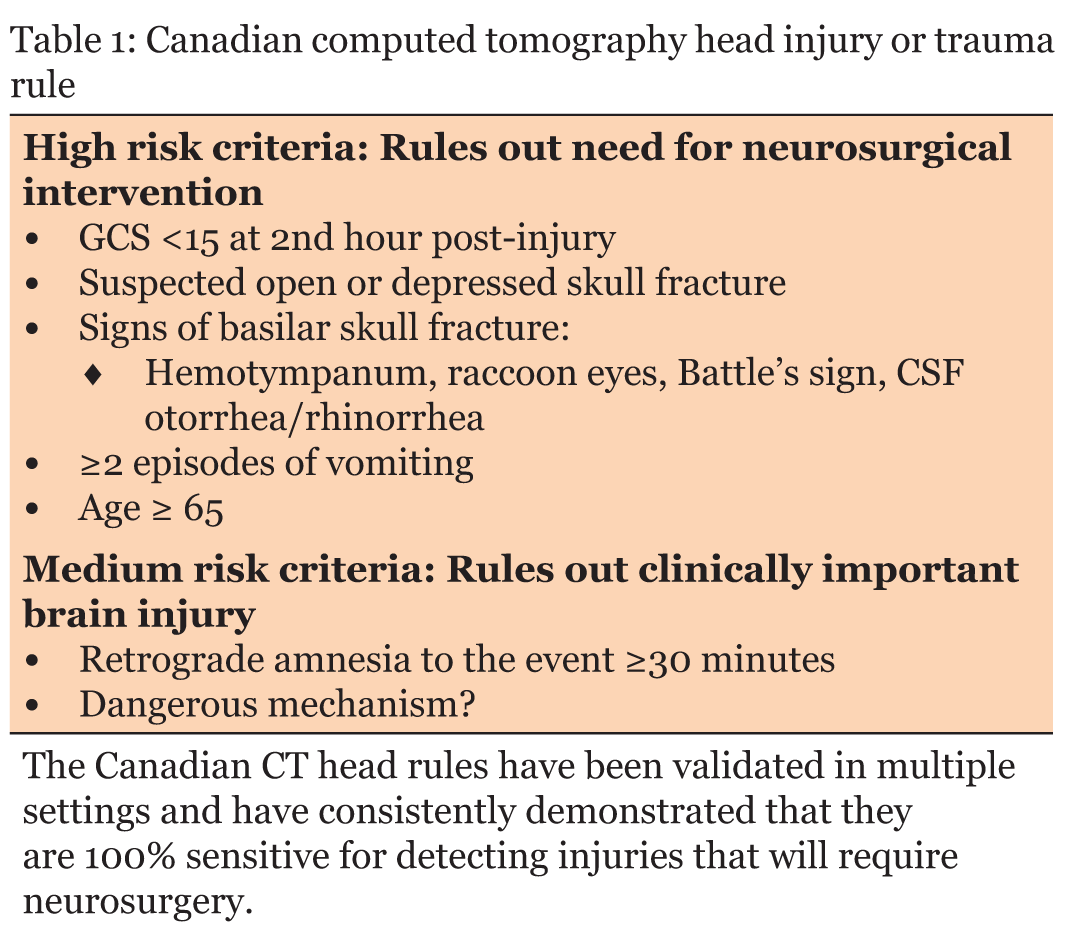
In terms of neuroimaging following head injury, the decision on whether or not to scan tends to be guided by hospital-specific protocol, or is physician dependent. The general consensus, however, is that patients with new clinical symptoms or a change in GCS following head injury, should undergo a computed tomography (CT) scan of the brain. The specific clinical predictors for this are still very much debateable. The Canadian CT head rule study, as demonstrated in Table 1, has developed a highly sensitive clinical decision rule for the use of CT scan in patients with minor head injuries [5]. These patients are classified into whether or not imaging is required, based on the presence of five high-risk factors for neurosurgical intervention, and two medium-risk factors for clinically important lesions. The implementation of this guideline in other centers was associated with a modest reduction in CT use and an increased diagnostic yield of head CT scan for trauma to the head [6] [7]. Computed tomography scans are used in the assessment of head injury as they have widespread availability, rapid scanning times, and are compatible with medical devices. Furthermore, they are sensitive in demonstrating significant pathologies such as mass effect, abnormal ventricular size and configuration, bone injuries, as well as acute hemorrhage [8]. Despite its many advantages in the assessment of traumatic brain injury, CT scan is limited in that lesions with smaller dimensions than that of its resolution remain undetected [9]. Consequently, a common diagnosis of mild traumatic brain injury, or evidence of diffuse axonal injury (DAI), is likely to unnoticed on CT scans, and are better visualized with magnetic resonance imaging (MRI) [10] (Table 2). Magnetic resonance imaging scans, on the other hand, provide superior soft tissue details, compared with CT scans, when evaluating complicated minor traumatic brain injury, including improved ability to detect DAI [11] [12] [13]. In spite of this, the drawbacks of MRI include its limited availability in the acute trauma setting, long scanning times, high sensitivity to patient motion, poor compatibility with various medical devices, and relative insensitivity to subarachnoid hemorrhage. Diffuse axonal injury is a complication of traumatic brain injury induced by sudden acceleration-deceleration or rotational forces and the subsequent tissue injury is characterized by axonal stretching, disruption and eventual separation of nerve fibers in the white matter [14]. Current imaging modalities in clinical use tend to underestimate DAI, and while MRI scan does have better resolution than CT scan in detecting this pathology, there is still a high rate of false negative results for small lesions and milder forms of DAI [15]. Previous studies have quantitatively demonstrated that CT scans miss approximately 10–20% of abnormalities seen on MRI [13] [16]. Although MRI scans have greater sensitivity in detecting smaller lesions such as DAI, it is unclear whether the recognition of additional lesions on MRI would impact acute management of head trauma [9]. In light of the above information, and as CT scans are more convenient in the acute setting with an ability to evaluate for the four types of cranial hemorrhages, the current preference is to initially CT scan a patient following head injury, rather than use MRI scan. There is a role, however, for MRI scan in patient following the initial 48-hour observation period whose symptoms continue to persist [17]. | ||||||
| ||||||
| ||||||
|
CONCLUSION
| ||||||
|
While current protocols guide us on when to image in the acute setting of head trauma, there is still difficulty in accurately diagnosing mild traumatic brain injury and its sequela, such as diffuse axonal injury. The approach of performing a CT scan of the head in the acute setting and then either a CT scan or MRI scan after 48–72 hours seems the most appropriate method of imaging. | ||||||
|
REFERENCES
| ||||||
| ||||||


|
[HTML Abstract]
[PDF Full Text]
|
|
Author Contributions
Jonathan Sivakumar – Substantial contributions to conception and design, Acquisition of data, Analysis and interpretation of data, Drafting the article, Revising it critically for important intellectual content, Final approval of the version to be published |
|
Guarantor of Submission
The corresponding author is the guarantor of submission. |
|
Source of Support
None |
|
Conflict of Interest
Author declare no conflict of interest. |
|
Copyright
© 2017 Jonathan Sivakumar. This article is distributed of Creative Commons Attribution License which permits unrestricted use, distribution and reproduction in any medium provided the original author(s) and original publisher are properly credited. Please see the copyright policy on the journal website for more information. |
|
|