|
Case Report
Perforated gallbladder after cystic artery pseudoaneurysm embolization: A case report and review of the literature
1 Lecturer, Diagnostic and Intervention Radiology Department, Faculty of Medicine, Assiut University, Assiut, Egypt
2 Assistant lecturer, Diagnostic and Intervention Radiology Department, Faculty of Medicine, Assiut University, Assiut, Egypt
Address correspondence to:
Ramy Ahmed
Diagnostic and Intervention Radiology Department, Assiut University 71515, Assiut,
Egypt
Message to Corresponding Author
Article ID: 100169Z12RA2026
Access full text article on other devices

Access PDF of article on other devices

How to cite this article
Ahmed R, Ahmed A. Perforated gallbladder after cystic artery pseudoaneurysm embolization: A case report and review of the literature. J Case Rep Images Surg 2026;12(1):20–24.ABSTRACT
Introduction: Cystic artery pseudoaneurysm (CAP) is an uncommon complication of cholecystitis. Transarterial embolization is an effective treatment for CAP rupture, but it carries a theoretical risk of gallbladder (GB) ischemia, which is rarely reported.
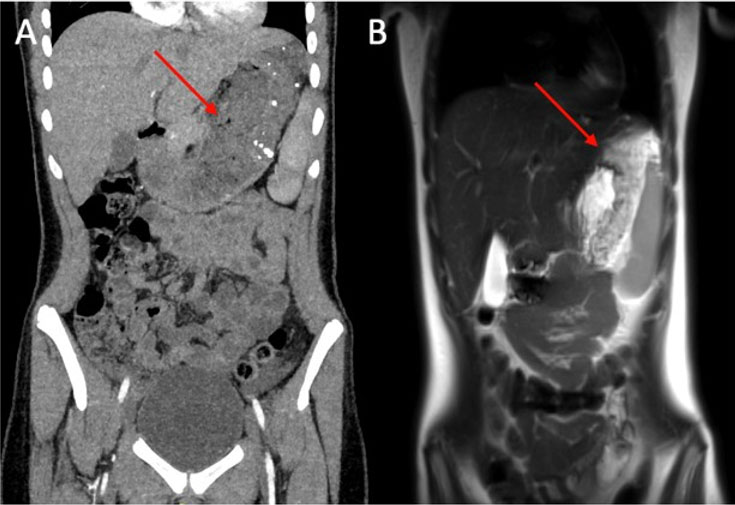
Case Report: A 75-year-old diabetic woman who presented with acute calculous cholecystitis complicated by CAP rupture, manifesting as massive hematemesis and melena. Urgent angiography demonstrated a large cystic artery pseudoaneurysm, which was successfully embolized using an NBCA–Lipiodol mixture. One week after embolization, the patient developed fever and right upper quadrant pain. Imaging revealed a perforated, gangrenous gallbladder with a large subhepatic abscess. As the patient was a poor surgical candidate, percutaneous transhepatic drainage was performed, resulting in complete resolution of the abscess and clinical recovery. This case highlights that the fear of gallbladder perforation should not contraindicate life-saving cystic artery embolization, as it remains amenable to minimally invasive treatment.
Conclusion: Gallbladder ischemia and perforation following cystic artery embolization are rare but important complications. In surgically unfit patients, percutaneous catheter drainage can provide an effective, minimally invasive alternative to cholecystectomy.
Keywords: Cystic artery pseudoaneurysm, Gallbladder perforation, Percutaneous drainage, Transarterial embolization
SUPPORTING INFORMATION
Author Contributions
Ramy Ahmed - Substantial contributions to conception and design, Drafting the article, Revising it critically for important intellectual content, Final approval of the version to be published
Abdelrahman Omar - Substantial contributions to conception and design, Acquisition of data, Revising it critically for important intellectual content, Final approval of the version to be published
AcknowledgmentsThe authors acknowledge Microsoft Copilot software for assisting with language editing of the manuscript.
Artificial intelligence (AI) use in the article:
Microsoft Copilot was used to assist with language editing of the manuscript. The tool was not used to generate any data in the article. All AI-generated suggestions were reviewed and approved by the authors. All content remains the authors’ original work, and the authors take full responsibility for the final manuscript.
The corresponding author is the guarantor of submission.
Source of SupportNone
Consent StatementWritten informed consent was obtained from the patient for publication of this article.
Data AvailabilityAll relevant data are within the paper and its Supporting Information files.
Conflict of InterestAuthors declare no conflict of interest.
Copyright© 2026 Ramy Ahmed et al. This article is distributed under the terms of Creative Commons Attribution License which permits unrestricted use, distribution and reproduction in any medium provided the original author(s) and original publisher are properly credited. Please see the copyright policy on the journal website for more information.